
Conway SC Clay Soil: What Every Homeowner Must Know About Concrete
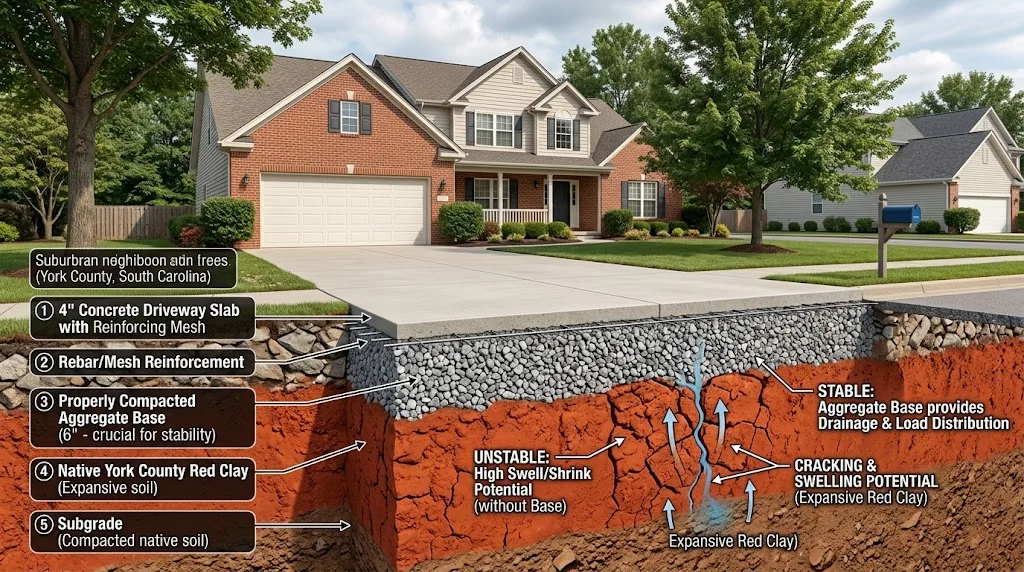
Every year, Conway homeowners pour thousands of dollars into concrete driveways, patios, and slabs that crack within five to ten years — not because the concrete was bad, but because the ground beneath it was never properly prepared. The culprit is Horry County’s expansive clay soil, and understanding how it behaves is the single most important thing you can know before starting any concrete project in Conway. In this post, we cover what clay soil does to concrete, how the problem shows up in local neighborhoods, and what the right installation approach looks like.
Concrete Built for Conway's Clay Soils
Conway Concrete Pros engineers every project for Horry County's local soil conditions. Free estimates.
Why Conway’s Clay Soil Matters for Concrete Projects
Horry County’s soils are classified as clay-loam dominant in most residential areas, with expansive clay concentrated at the surface and intermediate depths. Expansive clay has a defining characteristic: it absorbs water and swells, then loses water and shrinks. This shrink-swell cycle isn’t a minor nuisance — in a wet South Carolina climate like Conway’s, the soil beneath a concrete slab can move vertically by an inch or more between the wettest months (July–September, with over 14 inches of combined rainfall) and the drier fall period.
When the soil swells, it pushes upward on concrete slabs from beneath. When it shrinks, it pulls away, leaving voids. A slab without adequate reinforcement or a properly engineered sub-base is essentially being bent repeatedly. Hairline cracks appear first — usually within 3–5 years of installation on improperly prepared sites. Within 10 years, those cracks have widened, water has entered, and the cycle has accelerated. In Carolina Forest, where rapid residential development placed hundreds of homes on fill material over clay, this pattern appears in driveways and patios at a rate that surprises many homeowners.
Get a Site Assessment in Conway SC
We evaluate your soil conditions before recommending any concrete approach. No obligation.
Types of Soil Damage and What They Look Like
Shrinkage cracking runs through the concrete in roughly parallel lines or a map pattern. This is caused by the soil contracting beneath the slab and is most visible in Conway during fall and after dry stretches. The cracks often appear at control joints first, then spread.
Heave cracking lifts sections of the slab unevenly, creating a raised edge on one side of a crack. This happens when wet clay expands beneath one section of the slab more than another — common near downspouts, in low drainage areas, or along foundations where water concentrates.
Settlement cracking drops one section of the slab relative to another, creating a step at the crack. This occurs when a void forms beneath the slab and the concrete can no longer support its own weight without deflecting.
Surface scaling — where the top layer of concrete flakes away — is accelerated when clay soils create drainage problems that keep water in contact with the concrete surface longer than normal.
Practical Uses: Protecting Your Concrete from Clay Soil
Driveways near the Waccamaw River: Properties in the Riverfront neighborhood and along River Road face elevated groundwater during wet seasons. Driveways here require deeper excavation and a more substantial gravel base — typically 6–8 inches rather than the standard 4. Skipping this step is the most common reason driveways in this zone fail early.
Patios in Carolina Forest: The master-planned community’s rapid build-out means many lots have varying fill depths and compaction levels. Patio slabs here benefit from additional reinforcement — rebar on 18” centers rather than wire mesh — and expansion joints every 8–10 feet rather than the standard 12. These additions add modest cost but dramatically extend the patio’s useful life.
Garage floors in Conway Plantation: Established neighborhoods like Conway Plantation often have relatively stable soil, but clay is still present. Vapor barriers beneath garage slabs prevent moisture migration that can cause surface efflorescence and eventually spall the floor surface.
New construction slabs in Red Hill: Red Hill’s rapid growth (+5.78% annually) means many slabs are being poured on recently graded lots where fill hasn’t fully consolidated. Time and proper compaction testing before pouring are the most important quality measures for new construction concrete in this area.
Foundation perimeter slabs: For any concrete adjacent to the home’s foundation, drainage slope is critical. A minimum 2% grade away from the foundation over the first 6 feet prevents the soil saturation that drives both concrete cracking and foundation movement.
Shed pads and utility pours: Even small utility slabs in Horry County benefit from a 4-inch compacted gravel base. Sandy pockets beneath smaller pads can drain rapidly and leave voids that cause the pad to shift and crack within a few years.
How a Proper Installation Addresses Clay Soil
The solution to clay soil isn’t a thicker slab alone — it’s addressing the soil condition directly. A proper installation for clay-soil conditions in Conway includes excavating 6–8 inches, removing unstable native material, compacting a layer of clean crusher run or crushed stone, and verifying compaction with a plate compactor before forming. This sub-base creates a stable, well-draining platform that doesn’t move with moisture.
On top of this base, reinforcement is critical. Wire mesh handles light residential loads and minor shrinkage stress. Rebar is better for heavier applications or areas with known poor drainage. Fiber-reinforced concrete mixes add crack resistance without changing the installation process. Control joints cut or tooled at 8–10 foot intervals give the concrete predictable places to relieve thermal and moisture stress — keeping cracking manageable and hidden rather than random and visible.
Frequently Asked Questions
How do I know if my Conway property has expansive clay soil?
Most Horry County residential lots have some clay content, but the extent varies. Signs of expansive soil include: doors and windows that stick seasonally, cracks in interior drywall that open and close with weather, and visible soil shrinkage cracks in yard areas during dry periods. If you see any of these on your property near Conway, expansive clay is likely present. Your contractor should assess site-specific soil conditions during the estimate visit — ask specifically whether they evaluate sub-base conditions before recommending an installation approach.
Can you repair concrete that was damaged by clay soil?
Yes, depending on the severity. Surface cracks and minor settlement can often be addressed with crack filling, mudjacking, or partial slab replacement. If the underlying drainage hasn’t been corrected, repairs will recur. For concrete on poorly drained clay-soil sites, addressing drainage is always part of a lasting repair. See our full guide on concrete repair vs replacement in Conway for decision-making guidance.
Is the clay soil problem worse in some Conway neighborhoods than others?
Yes. Areas near the Waccamaw River and in lower-elevation sections of Conway have higher groundwater and more saturated clay conditions, accelerating the shrink-swell cycle. Newer subdivisions on recently graded fill — particularly in Red Hill — have less consolidated soil and see faster initial movement. Well-established neighborhoods on higher ground with good natural drainage typically have more stable conditions. A site assessment during the estimate process identifies which conditions apply to your property.
Related: