
10 Questions to Ask Before Hiring a Concrete Contractor in Conway SC
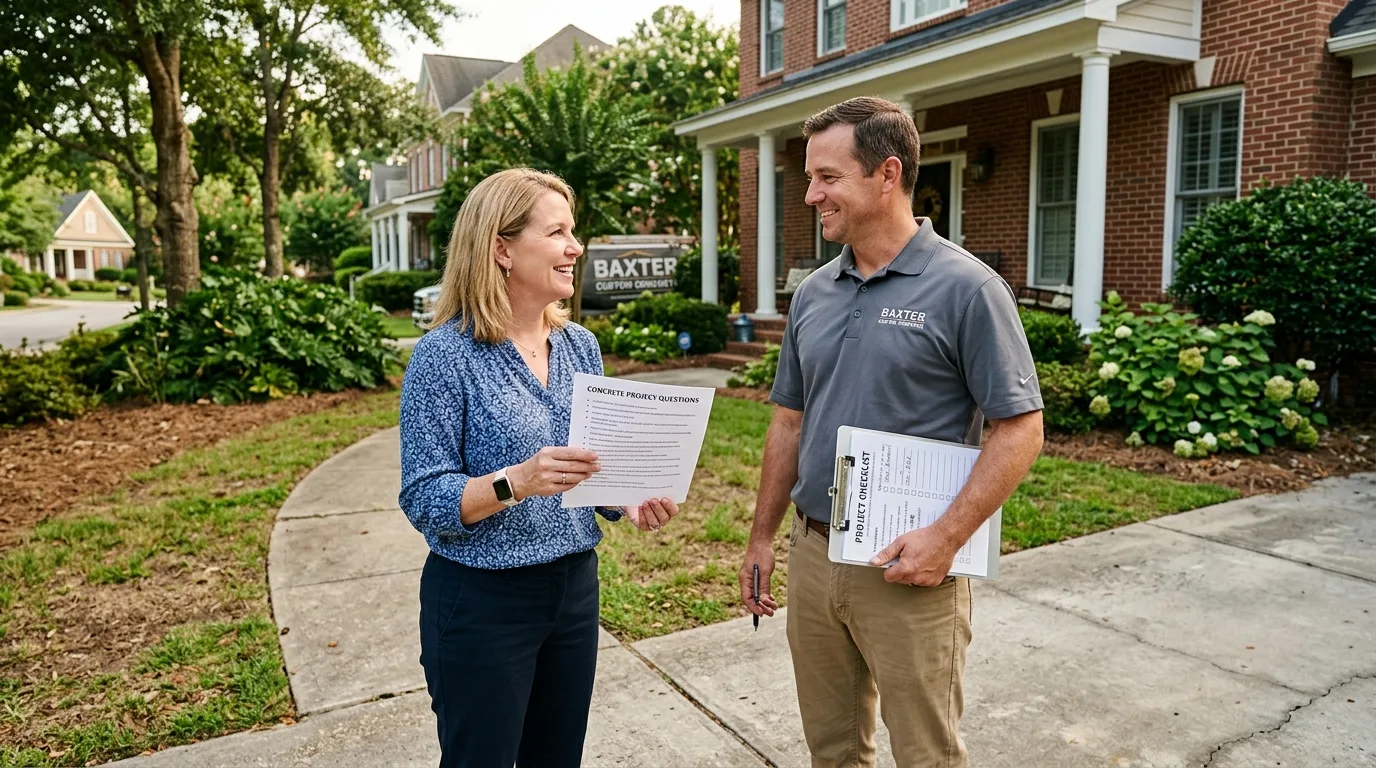
Hiring a concrete contractor in Conway SC is a decision that affects your property for decades. A well-executed driveway or patio lasts 30+ years. A poorly done one — with inadequate base prep, wrong mix design, or skipped drainage work — can fail in 5 to 10 years and cost you nearly as much to replace as the original job. The difference between these outcomes often comes down to which contractor you hire and whether you asked the right questions before signing anything. In this post, we cover the 10 most important questions to ask, what answers to look for, and what red flags to watch for in the Conway and Horry County market.
Conway Concrete Pros Welcomes Your Questions
We answer every question on this list before you sign anything. Free estimates throughout Horry County.
Why Vetting Matters More in Conway’s Market
The Myrtle Beach-Conway construction market is active, competitive, and diverse in contractor quality. Some of the area’s best concrete work comes from small, owner-operated companies with deep local roots. Some of the worst comes from out-of-area contractors who move into the coastal SC market during growth periods and lack local soil and climate knowledge. The vetting process described here filters for the things that matter in Horry County specifically: South Carolina licensing, local soil expertise, and honest approach to base preparation.
Conway’s expansive clay soils mean that a contractor’s sub-base approach is the most important quality indicator. A contractor who quotes the same price per square foot regardless of site conditions either isn’t evaluating soil conditions or is cutting corners on base preparation. Either way, that’s a contractor to avoid.
The 10 Questions
1. Are you licensed under South Carolina state law, and can I verify your license number?
South Carolina requires contractor licensing for residential work valued at $5,000 or more. The Residential Builders Commission and General Contractors’ Licensing Board maintain public license lookup databases. Any legitimate contractor provides their license number on request — you can verify it online before signing anything. Within the City of Conway, contractors must also hold a City of Conway business license. Red flag: hesitation, vagueness, or claims that small jobs “don’t need” a license.
2. Do you carry general liability insurance and workers’ compensation?
General liability insurance protects you if the contractor damages your property. Workers’ compensation covers workers injured on your property — without it, you could be liable for those injuries. Ask for a certificate of insurance listing you as the certificate holder. Any contractor who won’t provide this should be eliminated from consideration. Red flag: “we’re a small operation, we don’t need insurance.”
3. How will you prepare the sub-base for this specific site?
This is the most important technical question on the list for Conway homeowners. The correct answer describes: excavation depth, the material being used as the sub-base (crusher run, gravel, or equivalent), compaction method, and how they assess whether your site has drainage challenges or soft soil spots. A vague answer (“we’ll compact the ground”) or a dismissive one (“it’s fine, we’ve done many driveways here”) indicates inadequate base preparation protocol. Red flag: any contractor who doesn’t specifically ask about or observe your soil conditions before providing an estimate.
4. What concrete mix will you use, and what’s the PSI specification?
Residential driveways typically require 3,000–4,000 PSI concrete. Patios are similar. Anything below 3,000 PSI is inadequate for most applications in Conway’s climate. The contractor should be able to tell you the PSI, the water-cement ratio, and whether fiber reinforcement will be used. They should also explain how they manage curing in South Carolina’s heat — which is a real challenge for summer pours. Red flag: “we just use standard mix.”
5. What reinforcement will be used, and where?
For residential driveways and patios, wire mesh or fiber-reinforced concrete are appropriate for standard conditions. Rebar on 18” centers is better for heavy-use areas or sites with known drainage challenges. The contractor should specify what they’re using and why it’s appropriate for your project. Red flag: no mention of reinforcement at all, or “we don’t use rebar on residential jobs.”
6. How will you handle drainage for this project?
Every concrete surface needs positive drainage slope — minimum 1/4 inch per foot away from structures. On Conway’s clay soils, inadequate drainage is the single leading cause of premature failure. A good contractor asks about where water currently goes after rain and designs the new surface to improve drainage, not just maintain the status quo. Red flag: the contractor doesn’t mention slope or drainage in the estimate discussion.
Ask Conway Concrete Pros These Questions
We provide detailed written answers to every question on this list with every estimate.
7. What control joint plan will you use?
Control joints are the lines cut or tooled into concrete to guide where cracking occurs as the concrete expands and contracts. For driveways, joints should be spaced at roughly 10-foot intervals or at squares equal to the slab width. For patios, similar spacing applies. A contractor who can explain their joint plan demonstrates understanding of concrete behavior. Red flag: no mention of control joints, or “we’ll saw cut wherever it looks good.”
8. Do you pull permits when required, and are you familiar with Horry County’s requirements?
Horry County exempts residential driveways and freestanding patios from permits in most cases. Garage floors, foundation work, and commercial projects require permits. Any contractor working in Conway should know these rules cold. A contractor who says permits are never needed, or who suggests you “don’t need to bother with a permit” for a project that actually requires one, is either uninformed or cutting corners. Red flag: blanket statements about permits that don’t reflect the actual local requirements.
9. Can you provide three references from similar projects in Horry County within the past 12 months?
A concrete contractor serving Conway should have recent local references — not just testimonials, but actual phone numbers you can call. Ask the references specifically about: project timeline, final cost vs. estimate, quality of the base preparation (ask if they noticed any concrete problems in the first year or two), and whether they’d hire the contractor again. Red flag: inability to provide references, or references that are vague about project details.
10. What does your warranty cover, and what doesn’t it cover?
A reputable contractor warrants the workmanship — meaning if the concrete cracks or fails due to installation errors, they’ll address it. Most warranties exclude cracking caused by tree roots, vehicle overload, or external damage. What to watch for: warranties that exclude all cracking regardless of cause essentially warrant nothing. A reasonable warranty covers defects in workmanship for 1–2 years and is stated in the written contract. Red flag: verbal-only warranty promises, or warranties with exclusions that cover every possible failure mode.
Practical Uses
Using this list with multiple contractors: Get written estimates from three contractors and compare answers to these questions side by side. The contractor who addresses sub-base conditions, drainage, and reinforcement specifically will usually produce better work — even if their price is modestly higher. The price difference on a concrete driveway is typically $300–$800 between the cheapest and best options; the quality difference can be 15+ years of additional lifespan.
Verifying South Carolina contractor licenses: The SC Contractor’s Licensing Board allows license verification at scllr.sc.gov. Enter the contractor’s name or license number. Verify the license is active, the classification covers your project type, and there are no disciplinary actions on record.
Frequently Asked Questions
What should a concrete contract include for a Conway project?
A written contract should include: scope of work in detail (dimensions, thickness, reinforcement, finish type), concrete mix specification, drainage slope specification, control joint plan, start and completion dates, payment schedule (typically 10–20% deposit, balance on completion), warranty terms, and permit responsibility. Any contractor who resists providing this level of written detail before work starts is a red flag.
How do I compare concrete bids in Conway?
Compare bids on equivalent specifications. If one bid omits base preparation or specifies thinner concrete, it’s not a fair comparison to a complete installation. Ask every contractor to provide a written scope that matches the specifications in the most complete bid. Only then can you evaluate price vs. price. See our concrete driveway cost guide for current Conway market pricing by project type.
What’s the biggest mistake Conway homeowners make when hiring a concrete contractor?
Choosing on price alone without evaluating base preparation. The difference between a $4,000 driveway that lasts 30 years and a $3,200 driveway that needs repair in 10 is almost always in the sub-base work, not the concrete itself. Horry County’s clay soils make this more consequential than in many other markets. Ask specifically what the base preparation includes and get it in writing.
Related: